1868 - 1897
Mildred Jessup's
Life and Work
Mildred
Marion Bowes-Lyon was
the eighth child and second daughter
of the 13th Earl and Countess of
Strathmore and Kinghorne
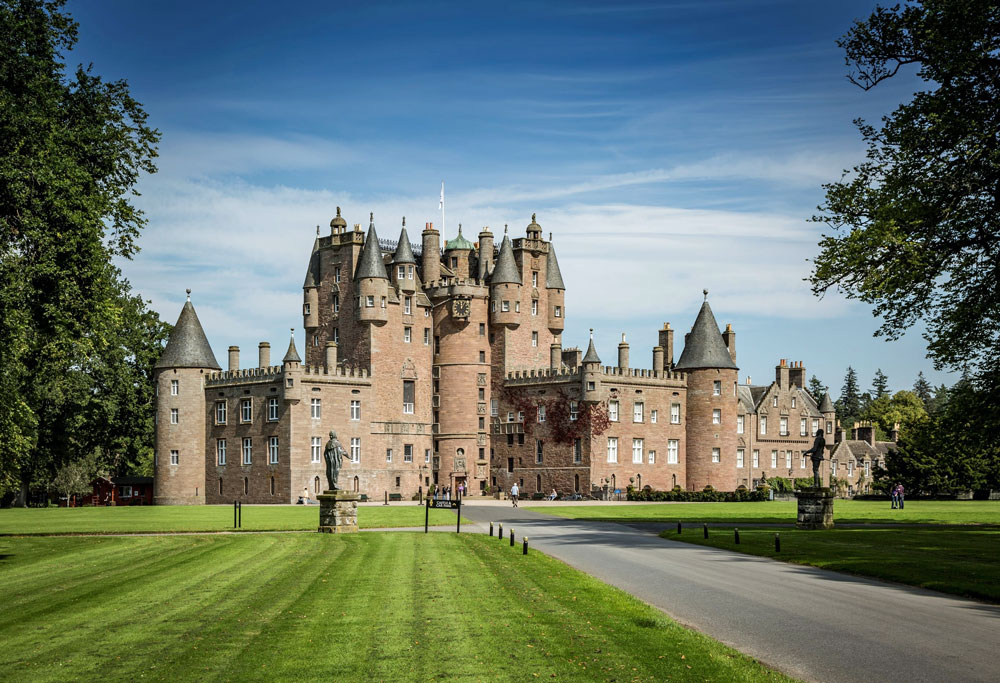
and was born at
Glamis Castle on 6 October
1868. Mildred's
brother, the 14th Earl, was the
present Queen's maternal grandfather
making Mildred her great aunt.
Her upbringing was much as would
be expected in an aristocratic,
well-connected,
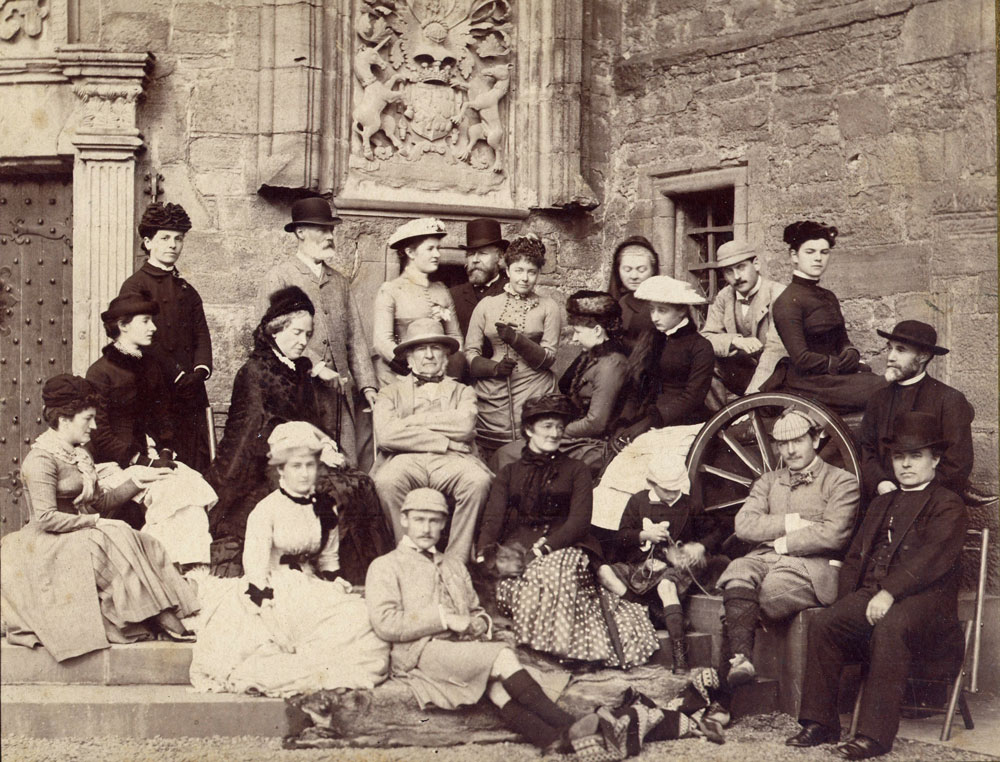
family. There is a
photo in the Glamis archive
of a visit by the then British Prime
Minister, William Gladstone,
which included an elegant
Mildred in the middle on the
left hand side.
|
Mildred was often described
as having delicate health
causing the family to decamp
to Egypt for the winter in
1888 and India in 1889
[1]. However, she was also
praised as "an excellent and
daring rider" [2]. Her
mother, Frances, was an
excellent pianist and
regularly played in charity
concerts along with her
daughters Constance and Maud
but more
rarely Mildred,
presumably because of her
health. Mildred does
not seem to have attended a
music institution although
she had some lessons from
John Farmer, organist at
Balliol College, Oxford in
1886 [3] and possibly from
Charles Pearce, at Trinity
College of Music in London,
to whom, initially, she sent
her opera for comment and
revision [4].
Only one opera by
her is known to have been performed, Etelinda (Ethelinda),
with a libretto by her husband,
Augustus
Edward Jessup (Gus), a wealthy
American, whom she married
on July 1, 1890. The
marriage was said to be the
first between a British
aristocratic woman and an
American man [5]. The
other way round was a
well-trodden path as
American money shored up
decaying aristocratic
properties in
return for a title.[6]
An article in
Lo Staffile (May
25, 1894, p.1)
claimed
that Gus was
travelling round Scotland
for pleasure and in search
of
|
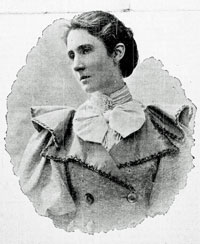
Lo Staffile,
May 25, 1894, p.1
www.internetculturale.it
|
ancient
legends when he met her and they
fell in love. It also claimed that
she did not become a
musician until she met him.
This is almost certainly an
exaggeration given her study
dates with Farmer but it may
be true that she only raised
her sights to more ambitious
works after she met him.
In 1893, Gus bought
and modernised the
Schloss at Lenzburg
in Switzerland
as their main residence but
they also had a villa at Valescure
on the French Riviera.
They had two children,
Alfred and Alexander.
Mildred died after a short
illness at Valescure on June 9, 1897.
The American
actress, Mary Anderson, later
described Mildred as "my most
intimate friend and a beautiful
woman" and how she and her younger
sister, Maud, had played
occasionally at a local Valescure
family's concerts [7].
Amongst
Mildred's other compositions were
claimed to be an
Intermezzo fantastico, a
psalm for choir and organ and a
symphony, while another
opera, probably Falca, was in progress
[8]. No music for these or any
lesser works has been found.
Books, articles,
online
Russell Burdekin, "The
Lady of the Winding Stair". Opera. Vo. 72. No. 9 (Sept
2021), pp. 1114-1120. This has now been expanded and
full references added,
see
Lady Mildred Jessup's Etelinda (Ethelinda)
|