  |
 |
 |
 |
 |
|
History
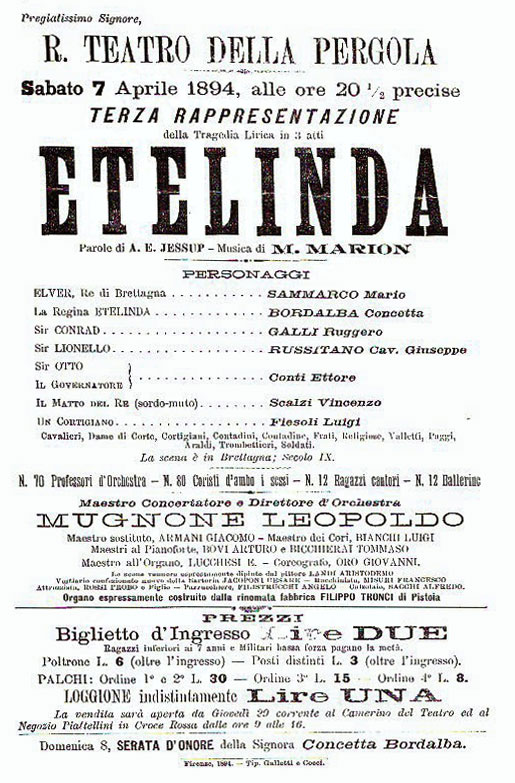
The premiere was given under the patronage of and in the presence of Princess Beatrice (Queen Victoria's daughter and Princess of Battenburg), her husband Prince Henry and many persons from the British court who were in Florence on account of Queen Victoria holidaying there (Daily News, Apr. 5, 1894; The Standard, Apr. 6, 1894). No mention was made in either paper of Mildred Jessup as the composer. It was originally advertised as by a Mr. M. Marion (The Era, Mar. 24, 1894) and the libretto to be by an English poet, Mr Jessup. The libretto and (rather unusually at this time) the Italian - English synopsis sheet credited "M. Marion" with the music. Thus the opera's origins were unclear and in fact Mildred's participation was deliberately hidden, presumably in case it was a failure. It was not until April 11, 1894 that the St. James Gazette printed the correct attribution. A vocal score by Mugnone was privately printed in 1895 with Mildred Marion named as the composer.
PlotThe opera took its inspiration from various Tales of the Round Table involving King Arthur, Guinevere and Lancelot but, as Gus made clear in the libretto preface, finding that he had moved some distance from them he gave it an unrelated name. This explanation and Golisciani's particular involvement are open to some doubt. Gus had actually written an Italian text resembling large parts of Ethelinda but entitled Il nano (the dwarf) probably more than 20 years previously. The first version of Ethelinda, a so-called "Versione Ritimica" that followed the music closely, was printed privately in 1894 and was said to have been translated by Golisciani from an English text. However, large sections are identical to Il nano so possibly Gus was responsible. This was then followed by a "Libera Versione" in which Golisciani said he had rendered the initial version into more elegant Italian as well as renaming it Etelinda. In fact the final act had been changed considerably including a new final scene. This is what was performed. It might be that Gus's original Italian was thought too pedestrian but to save his blushes the idea of an English version as the source was invented. The plot of the performed version was:
The 1895 vocal score, now entitled Ethelinda, had a different final act, similar to that of Gus's earlier Il nano. The King does not disguise himself as a monk and Lionel is brought to the King having been captured attacking the castle to free Ethelinda. They overhear her final prayer and the King realises his mistake but is too late to stop the execution [7]. While changes being made as a result of a performance were hardly unusual, the magnitude of their scope was, particularly given the opera's apparent success and that the fact that "the third act and especially the finale, is declared to be a chef d'oeuvre" (Bow Bells, April 20, 1894, p. 405), echoing the review from Lo Staffile (Apr. 16, 1894, p.2). It seems possible that Golisciani had provided the reshaped final act and that the Jessups wanted to reassert complete authorship. Another reason might have been because ending with a duel to establish innocence resembled the final scene of Arthur Sullivan's Ivanhoe, first performed in 1891 to considerable but short lived success. The reappearance of King Elver also had echoes of that of King Richard in Ivanhoe.
ReceptionThe opera was accounted a success. The Earl of Strathmore, Mildred's father, noted in his diary for April 3 that in his party "all thought opera very pretty", not a very insightful comment for a tragic opera. The artists and Gus took a number of curtain calls but not Mildred [8]. However, with success achieved, on the second night, "in response to the calls of the audience, Lady Mildred came before the curtain and bowed her acknowledgements" (Graphic, Apr. 14, 1894, p.423). According to the Earl's diary (Apr. 6, 1894), the excitement left her feeling "seedy" and she spent the next day in bed. The St James Gazette (Apr. 11, 1894) noted that the performers were recalled eight or ten times and that the opera was "favourably received by a critical audience". The Graphic report referred to above spoke of the "...the measure of success that she has secured may be taken when it is borne in mind that the work was presented anonymously to the fastidious musical public of Florence, and upon the very first performance was rewarded with enthusiastic approval". It also thought that that it was the first successful opera by a woman, certainly true from a British viewpoint. There were the inevitable remarks that no one would believe it wasn't by a man [9]. The Lute (May 1894, p.320) claimed that the composer Pietro Mascagni "was present and declared himself delighted with the work". The Earl renamed his villa in Bordighera on the Italian Riviera Etelinda as a tribute to the opera's success, a name that it still has today [10]. The Musical News (May 12, 1894, pp.447-448) wrote that the performance "was such as to do full justice to the music" and elaborated that The opera is melodic in character, though it keeps strictly to the dramatic development of the play. There is use, but not abuse, of leitmotivs. The melody is not always original but never vulgar, and there is on the whole a certain fluency which testifies to an abundant vein, and to quick comprehension of the subject. The hunters' and peasants' choruses in the first act, and the chorus with organ in the third, are well elaborated and effective, and the one which closes the opera is highly effective. The concerted pieces remind one sometimes of the old forms, but are none the less of remarkable worth. The scene of Sir Conrad's death and the last duet between Sir Lionel and Ethelinda gives evidence of dramatic power, while in the course of the opera there are many beautiful passages full of expression, such as the phrase of the short duet which closes the first act in so effective manner, the appeal of the King to Ethelinda to swear her innocence, and Ethelinda's death. Le Ménestrel (Apr.15, 1894) quoted an Italian critic that it was "always in elevated taste, ... tending towards romanticism, but an overabundance of declamation that can cause a certain tiredness in the listener. Well constructed and a great facility of harmonisation." Lo Staffile (May 15, 1894, pp.1-2) gave a detailed appraisal of both plot and execution including that of the main soloists. Its more general conclusion was that "The melody ... caresses the ear and the heart and is gentle and conducted with care and refinement, demonstrating an uncommon skill and mastery of orchestral secrets". Although Queen Victoria did not go to the opera, Mildred was said to have played her some extracts (The Woman at Home, n.d. p.324), probably when the family visited her on April 9. Queen Victoria's journal for that date referred to the "musical Lady Mildred Jessup". That article also spoke of the opera as being "a triumphal refutation of the assertion that a woman cannot write a grand musical composition". The Shields Daily Gazette (April 13, 1894, p.4) still hadn't caught up with the composer's true identity and continued to cite M. Marion but it did note the opera's "extraordinary success" and that "the brindisi, in the second act, received quite an ovation, and other songs were loudly applauded". It also surmised that "No doubt arrangements will speedily be made to bring the new opera to the notice of a London audience", but that never happened. The Earl's diary (Apr. 15, 1894) noted that Gus had reported for the final performance that "the theatre was packed full. Everyone enthusiastic. Confirmed lasting success" but it was not to be. Probably its success was not striking enough to persuade Italian impresarios to take it on given the competitiveness of the contemporary Italian opera scene [11]. Without wider Italian success its chances of being produced elsewhere would have been slight. While an English version in London might have been a possibility, the mid-1890s was a particularly inauspicious time for new productions as both Ethel Smyth and Charles Villiers Stanford found. It was almost certainly never performed again until in Scotland in 2019.
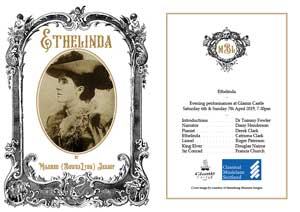
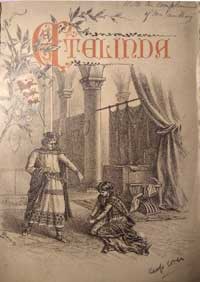
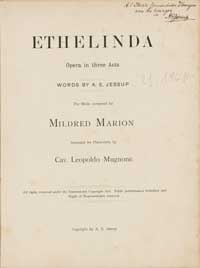
Scores and librettosThe four source documents referred to above are :-
RecordingsNo recording of either it or any of its numbers is known.
Books, articles, onlineRussell Burdekin, "The Lady of the Winding Stair". Opera. Vo. 72. No. 9 (Sept 2021), pp. 1114-1120. This has now been expanded and full references added, see Lady Mildred Jessup's Etelinda (Ethelinda)
[1] Enrico Golisciani (1848-1918) was a well established librettist and author eventually writing over 80 librettos (http://www.treccani.it/enciclopedia/ ). He wrote for, amongst others, Amilcare Ponchielli, Francesco Cilea and, most successfully, for Ernanno Wolf-Ferrari as well as three set to music by Leopoldo Mugnone, the best known being Il birichino of 1892. [2] Charles William Pearce was a respected London musical academic, administrator, organist, composer and author, see Broad Nib, "Dr. Charles W. Pearce", The Musical Journal. Vol 22, Issue 260 (August, 1909), pp.160-162. [3] The 13th Earl of Strathmore's diary entries for January 25 and February 8, 1894. [4] Leopoldo Mugnone (1858-1941) was a well known conductor and composer, who worked with
Golisciani on several operas. He conducted the premiere of Mascagni's Cavalleria rusticana in 1890 and
Puccini's Tosca in 1900. [5] Now known as the International Herald Tribune [6] The Standard (June 11, 1897), when reporting Mildred's death, spoke of the opera having had "great success" in Italy and Germany while the Musical News (September 1, 1894, p.181) spoke of a plan to perform it at the Theatre Royal in Madrid in 1895. [7] In the earlier "Versione Ritmica", Lionel lowers his visor and strides off never to be seen again. There is a duet between the king and Ethelinda giving her another chance to recant before she is taken to be executed. The impression is that Golisciani had decided a new final scene was necessary but that one had not been devised at that point. [8] Le Monde Artiste (Apr. 14, 1894) p. 208 [9] Illustrated Sporting and Dramatic News (Oct. 19, 1895), p 231 [10] Gisella Merello, The British Royal Family in Bordighera. Trans. Marcus
Bicknell. <https://www.clarencebicknell.com/images/ [11] The Gazzetta Musicale reported that there were 60 successful new Italian operas in 1894 including Etelinda (Illustrated Sporting and Dramatic News, Jan.26,1895, p. 726). |



 |
 |
 |
  |
|
|